




Hospitality leaders ask us this all the time, in one form or another: what are menu updates actually costing us? Not the menu itself but the operations around it — keeping prices, descriptions, and items current across print, as well as signage, web listings, POS, online ordering, and QR codes.
The answer is different for every organization, but they often have the same components.
For a mid-market restaurant group, the annual overhead cost can run somewhere between $80,000 and $120,000. But instead of showing up cleanly on invoices, the cost is hidden in day-to-day operations: marketing manages the design system and distribution channels, local operators make location-level changes, and IT maintains POS data.
Finance sees a handful of bills from different vendors while the cost burden of the tasks themselves gets lost in translation.
5 Hidden Costs of Menu Updates
The Five Buckets
1. Designer and stakeholder hours.
Every change consumes design time and a review cycle. Tracking which version is current — across reviewers, across surfaces — often takes longer than the design work itself.
2. Communication overhead.
Update requests get scattered across email, chat, sticky notes, and hallway conversations. Project management tools help some groups, but the requests still live outside the menu system.
Most of the rework we hear about traces back to a missed thread or a request that got buried.
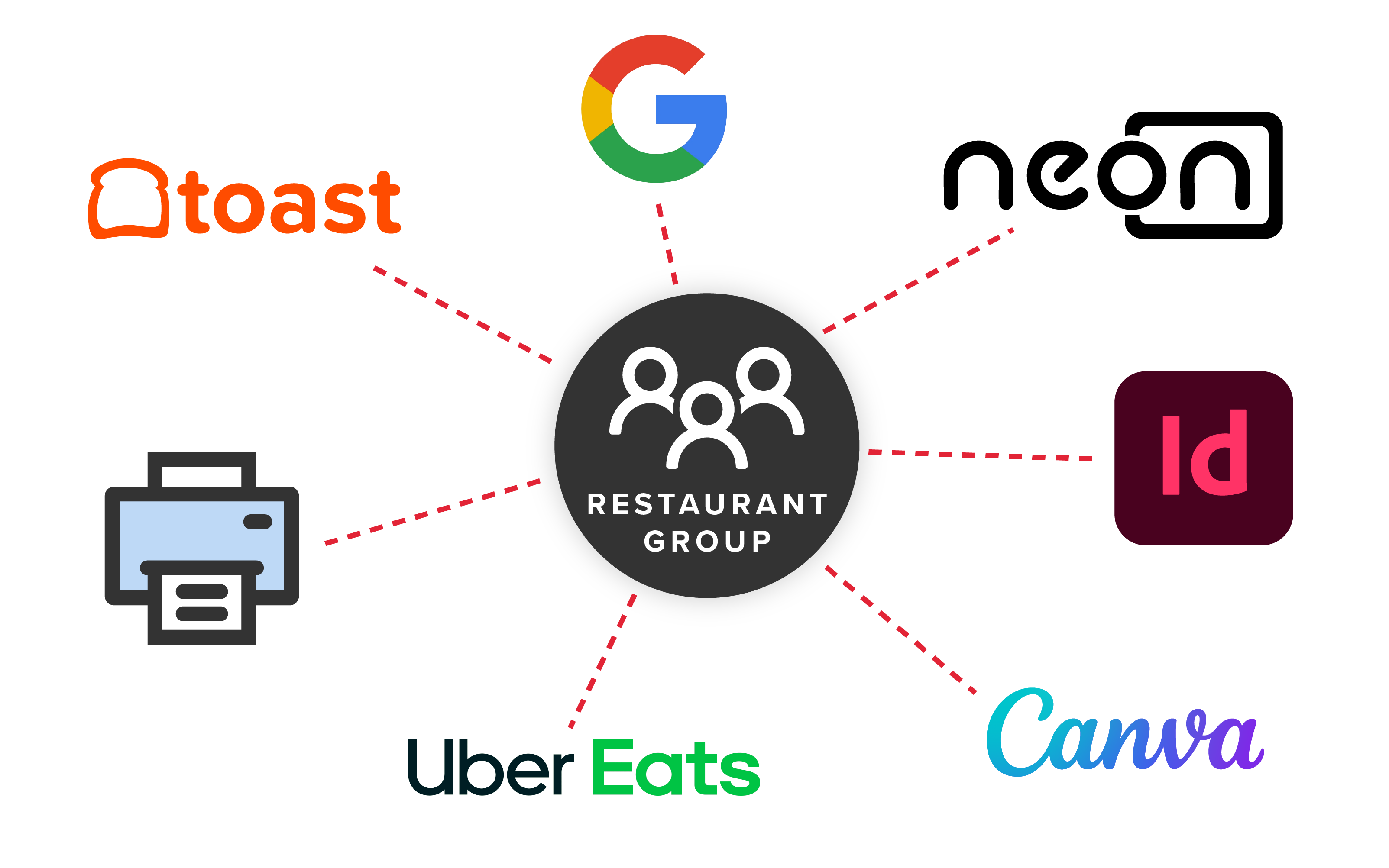
3. Multi-Vendor Coordination.
A mid-market group will typically manage menus across a design app, a print shop, a signage provider, a web listings distribution platform, an order aggregator platform, and a POS. Sometimes more. Each one is a separate vendor relationship to coordinate.
4. Re-keying across systems.
Once a change is approved, someone has to enter it into every vendor system by hand. Per change, the work is modest. Over a year, with hundreds of changes, it isn’t.
5. Promotions that don’t run.
When the workflow can’t keep up, promotional windows shrink or close entirely. The cost is whatever lift the LTO would have produced, which never gets booked because the LTO never ran.
Example Hidden Costs
Consider a 40-location restaurant group making one menu change a week. Here are illustrative numbers, not benchmarks:
| Bucket | Cost |
|---|---|
| Designer and stakeholder hours | $30,000 |
| Communication overhead | $28,000 |
| Multiple vendor management | $12,000 |
| Re-keying across systems | $10,000 |
| Abandoned promotions | $20,000 |
| Total | ~$100,000 |
Your number will depend on your footprint, vendor mix, and the frequency of menu changes.
 NOTABLE
Fewer Logins, Fewer Bills
The communication, re-keying, and vendor-coordination buckets exist because menu data lives in five separate places. Put it in one, and most of that cost goes away. That’s what we built MustHaveMenus to do. If your group is running a stack like the one above, we can walk you through what consolidation would look like in a quick half hour.